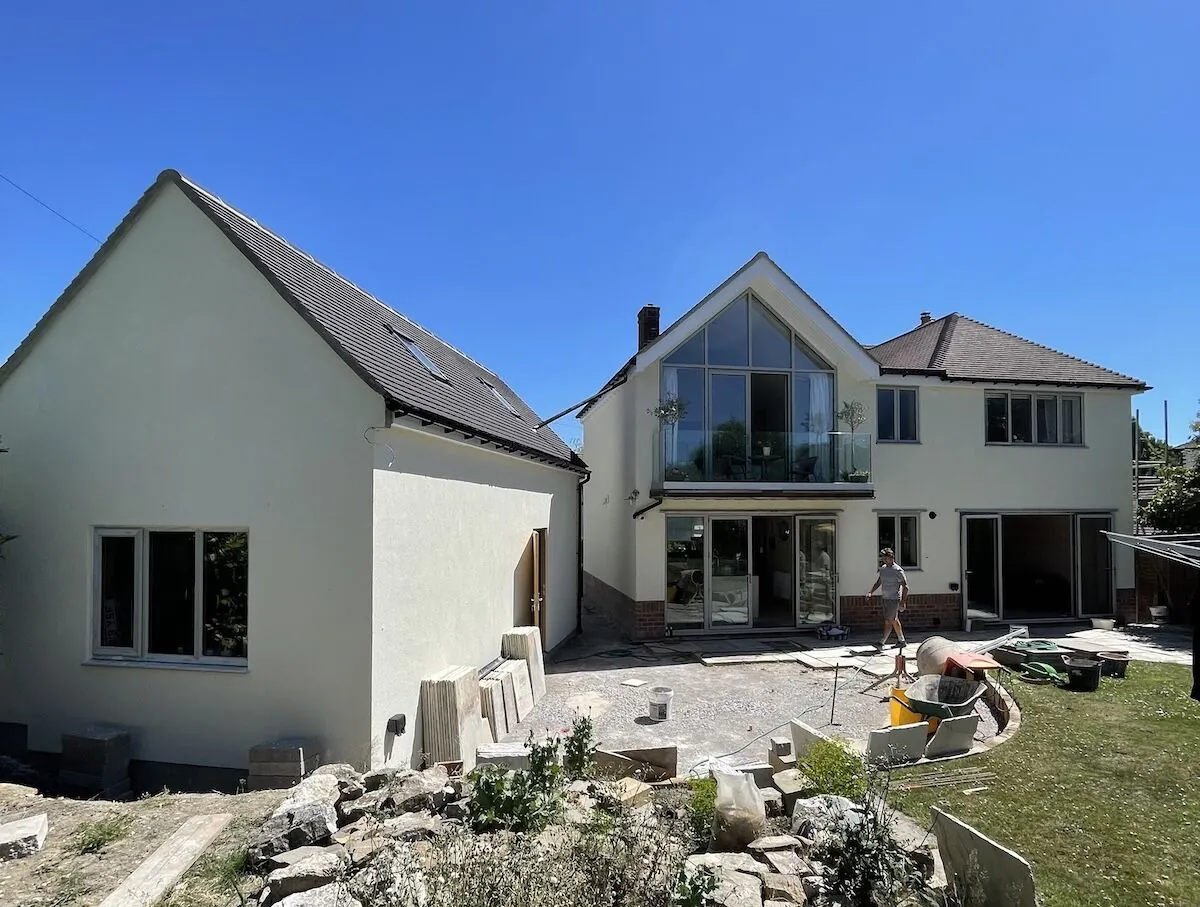
For most Sheffield homes, monocouche render (£70–80/m²) is the best-value answer — a long warranty and a superb through-coloured, stone-textured finish. Silicone render (£75–90/m²) costs just £5–15/m² more and is worth it where wall exposure is high, damp is a concern, or you want the lowest future maintenance. Both are paint-free and last 20–25 years.
Quick Comparison: Silicone Render vs Monocouche
Both systems are high-quality, long-lasting external renders that require no painting and carry lengthy manufacturer warranties. The differences come down to cost, hydrophobic performance, finish texture and planning suitability. Here is the full side-by-side breakdown:
| Feature | Silicone Render | Monocouche Render |
|---|---|---|
| Cost per m² | £75–90 | £70–80 |
| Warranty | 25 years | 20–25 years |
| Self-cleaning | Yes — hydrophobic surface | Partial — through-colour resists fading |
| Flexibility / crack resistance | Excellent — flexible polymer binder | Good — cement-based, slightly stiffer |
| Colour options | 150+ pre-pigmented colours | 50+ pre-pigmented colours |
| Painting required | No — colour is integral | No — through-colour system |
| Conservation areas | Sometimes not permitted | Yes — often preferred by planners |
| Best for | Long-term stay, moisture-prone or south-west facing wallsPremium | Best value, period properties, conservation areasPopular |
Both prices include materials, scaffolding, installation, waste removal and written guarantee. No hidden extras.
What Is Silicone Render?
Silicone render is a polymer-modified external render system that uses silicone as a binder within the top coat. The silicone gives the render a hydrophobic (water-repelling) surface that actively beads and sheds rainwater rather than absorbing it.
In practice, this means the wall stays drier, algae and mould have far less opportunity to establish, and the render surface self-cleans with each rain shower — dirt and biological growth are carried away rather than sitting in the surface pores. On a Sheffield property that faces the prevailing south-west winds and rainfall, this behaviour makes a real, visible difference over the years.
Silicone render is applied as a two-coat system over a base coat render and reinforcing mesh. The finish coat is available in a wide palette — over 150 factory-pigmented colours — and requires no painting, ever. The colour is part of the product and is covered by the 25-year manufacturer warranty.
Key benefits of silicone render for Sheffield homes
Silicone chemically repels water. Rain beads off the surface rather than being absorbed, keeping the wall fabric drier and reducing the risk of frost damage and damp penetration.
Dirt, algae spores and biological matter cannot grip the hydrophobic surface easily. Each rain shower washes the face clean, maintaining the original appearance with minimal maintenance.
The polymer binder gives silicone render superior flexibility compared to cement-based systems. This helps it accommodate minor structural movement without cracking — important in Sheffield's older housing stock.
With 150+ factory-pigmented colours available, silicone render offers greater design flexibility than monocouche. Colours are UV-stable and covered by the manufacturer warranty.
What Is Monocouche Render?
Monocouche is a single-coat through-coloured render system based on a cement, lime and aggregate mix with factory-added mineral pigments. The name comes from the French for "single layer" — it is applied in one coat directly to the prepared substrate and scratch-textured or scraped to achieve the finished appearance.
Because the colour runs throughout the full depth of the coat, minor chips or surface abrasion are invisible — unlike a painted finish, there is no white or grey substrate beneath. This makes it exceptionally durable in appearance terms and eliminates any future need to repaint.
The textured, slightly matte finish that monocouche produces is important in planning terms. It closely replicates the look of traditional sand-and-cement render and original pebbledash that Sheffield's conservation officers and planners recognise as appropriate for the area's Victorian and Edwardian housing. For properties in or adjacent to Sheffield's conservation areas, monocouche is frequently the system that planning officers will actually approve.
Key benefits of monocouche render for Sheffield homes
Monocouche's textured, through-colour finish is widely accepted — and often required — in Sheffield's conservation areas including Nether Edge, Broomhill and Crosspool.
At £70–80/m² fully installed, monocouche delivers excellent longevity and a 20–25 year warranty at a lower entry price than silicone. For most Sheffield homes, it represents the optimal value proposition.
The pigment runs throughout the full depth of the coat. Chips, scratches and weathering do not expose a different-coloured substrate. The render looks consistent and maintained with no effort.
The slightly textured, solid finish of monocouche suits Sheffield's Victorian and Edwardian terraces and semis far more naturally than a smooth, high-sheen silicone system.
Not Sure Which System Suits Your Property?
We survey hundreds of Sheffield properties each year. Book a free site visit and we will advise you honestly — including whether your property is in a conservation area and which system planners are likely to accept.
Sheffield's Climate — Why Hydrophobics Matter Here
Sheffield receives approximately 800mm of rainfall per year — significantly above the UK average of around 650mm — and sits at an elevation that exposes properties on the western and south-western edges of the city to prevailing Atlantic weather systems throughout autumn and winter. Streets in areas like Fulwood, Crosspool, Lodge Moor and Stannington regularly experience driven rain that soaks elevations that a drier city would rarely challenge.
The majority of Sheffield's housing stock was built between 1880 and 1960. These properties were not designed with modern breathable render systems in mind — many have solid walls, ageing pointing and brickwork that is already carrying some moisture. A render system that actively repels water rather than simply limiting absorption makes a meaningful difference to the long-term health of the wall fabric.
For walls that face south-west — the direction from which Sheffield's heaviest rain arrives — this hydrophobic performance gap between silicone and monocouche is most relevant. On sheltered elevations or walls facing north and east, the difference is less pronounced and monocouche is an entirely appropriate system.
Sheffield terraced houses are a particular case worth noting. Many terraces have only the front and rear elevations exposed — party walls are shared with neighbours. The front elevation, often facing straight into the prevailing weather, accumulates far more rain than the rear in most street orientations. On these properties, the hydrophobic self-cleaning properties of silicone render tend to show the most visible long-term benefit, keeping the street-facing front looking clean and fresh with no intervention.
Which Is Better Value — Silicone or Monocouche?
The honest answer depends on your circumstances, but here is our straightforward assessment based on the hundreds of Sheffield properties we render each year:
- Your property is in or near a Sheffield conservation area
- You are looking for the best value system with a long warranty
- Your property faces north or east (less rain exposure)
- The architectural style is Victorian, Edwardian or traditional
- You want a textured, natural-looking finish
- Your budget is the primary consideration
- Your property faces south or south-west (high rain exposure)
- You have experienced moisture or damp issues in the wall fabric
- You plan to stay in the property long-term and want maximum longevity
- Low maintenance is a top priority — self-cleaning matters to you
- You want the widest colour choice, including lighter shades
- Planning restrictions do not apply to your property
For most Sheffield homeowners, monocouche is the right answer. It costs less, carries a long warranty and looks superb. The £5–15/m² premium for silicone render is genuinely worth paying when the exposure is high, damp is a concern, or low future maintenance is important — but for a sheltered property in a conservation area, it would be unnecessary spend.
Conservation Areas in Sheffield — Where Monocouche Is Preferred
Sheffield City Council manages a significant number of conservation areas across the city, covering many of the suburbs where rendering work is most common. In these areas, external alterations — including re-rendering — may require planning permission or at minimum compliance with conservation area policies that restrict the appearance of new finishes.
Monocouche render is generally well-received by Sheffield's planning officers in conservation contexts because its textured, through-colour finish is consistent with the character of traditional render finishes that the conservation designation aims to protect. The smooth, often lighter appearance of silicone render can be perceived as introducing an inappropriate modern character to a conservation area streetscape.
Sheffield conservation areas where monocouche is the more appropriate choice include:
- Nether Edge — large conservation area with dense Victorian terrace stock; monocouche is consistently the preferred system
- Broomhill — mix of Victorian and Edwardian properties; planners prefer textured through-colour finishes
- Crosspool — interwar housing with traditional render; monocouche maintains area character
- Ecclesall Road South corridor — residential properties adjacent to the Ecclesall conservation area boundary
- Walkley and Hillsborough — dense terraced streets with Article 4 directions in some sections
- Cathedral and city centre fringe — listed building adjacencies require careful system selection
This list is not exhaustive and conservation area boundaries change. We always recommend checking with Sheffield City Council's planning department before committing to a system. As part of our free site survey, we will advise you based on your postcode and property type — and flag any planning considerations before you make a decision.
Real Project Examples from Sheffield
Both systems feature regularly in our completed work across Sheffield and South Yorkshire. Here are two representative projects that illustrate how the choice plays out in practice:
A four-bedroom detached on Sandygate Road with a significant south-west facing front elevation. The owners had experienced moisture tracking through the original render during heavy westerly weather, and the existing finish was beginning to show biological growth despite being only twelve years old. We specified premium silicone render for the front and side elevations, where the rain exposure is greatest, and monocouche for the sheltered rear elevation. The hydrophobic silicone surface has remained clean and dry through two Sheffield winters. The owners report no further moisture concerns.
A Edwardian semi-detached in Dore with original stone facing to the ground floor and an upper storey that had been previously rendered in a failing pebbledash. The property sits within a sensitive area where planners prefer finishes that complement the stone architecture of the village. We specified monocouche in a warm off-white, scratch-textured to produce a finish consistent with traditional sand-and-cement render. Planning was straightforward. The through-colour system means the upper storey finish will remain consistent in colour with the stone below for the life of the warranty without any repainting programme.
Which Should You Choose? — Decision Framework
If you are still weighing up the options, run through this framework based on the most common decision points we discuss during site surveys:
Answer these questions to find your best system
The single most valuable step is a free site survey. We measure the wall area, assess the substrate condition, discuss your priorities and advise on the most suitable system — with no obligation and no sales pressure. Most of our customers know which system they want before we leave.