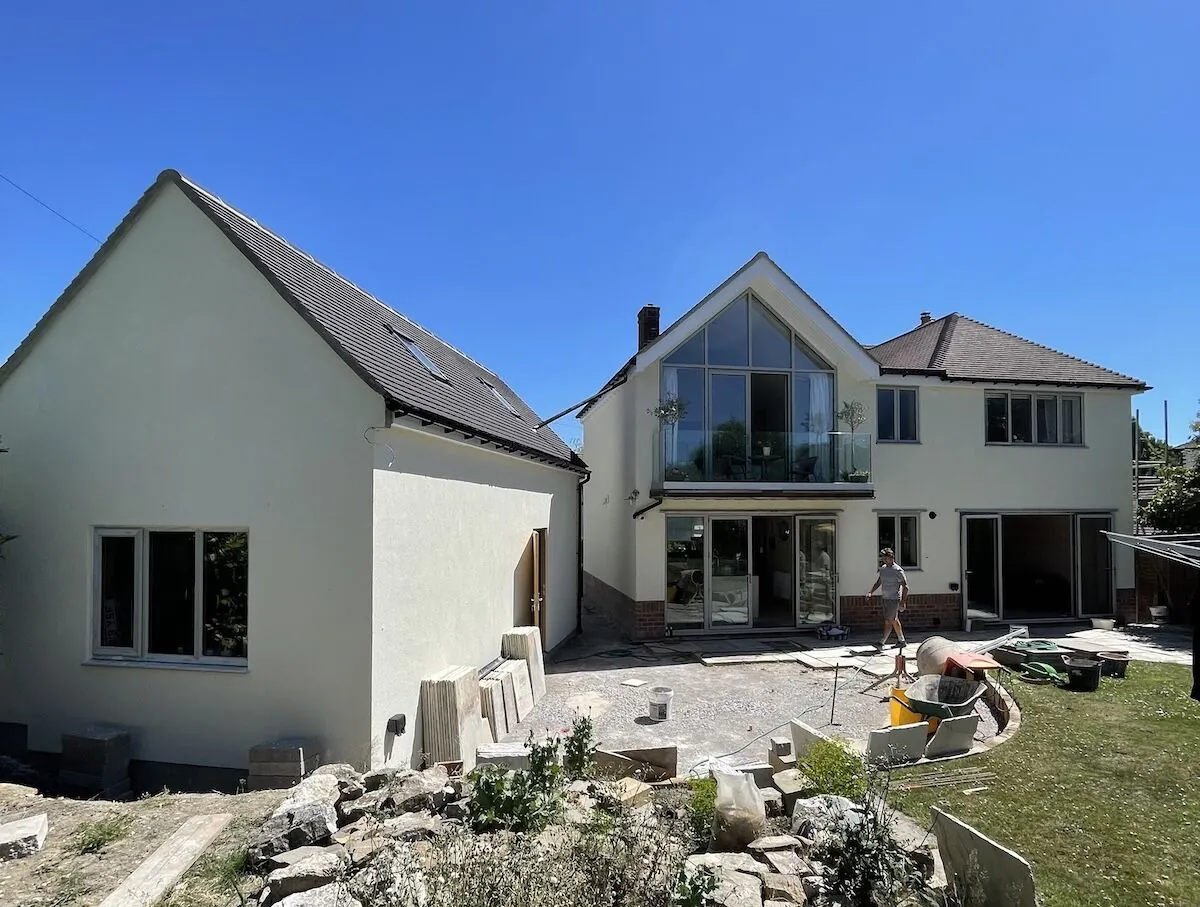
Can you render over pebbledash? In most cases, yes. If the pebbledash is sound and well bonded to the masonry, we apply a reinforcing mesh base coat and then the silicone finish straight over the top. Where sections are hollow, cracked or failing, those areas are stripped back to the masonry first. Rendering over sound pebbledash avoids a removal bill that UK cost guides put at roughly £2,100–£7,800.
The short answer, and the one thing that decides it
Almost everyone asking this wants to hear one of two things: that the pebbledash can stay, or that it has to go. The honest answer is that it comes down to a single test — and it is one you can do yourself in ten minutes.
New render is only ever as sound as whatever it is stuck to. That sentence decides the whole job. Pebbledash still firmly bonded to the brickwork is a perfectly good base; it is rough, which actually helps the base coat grip. Pebbledash that has let go behind is not a base at all. It is a layer waiting to fall off, and anything applied on top of it comes away with it.
How to test your own pebbledash
Take the handle of a screwdriver and tap firmly across the wall, working in a grid, covering every elevation you can reach safely from the ground.
- A solid, dull knock — the pebbledash is still bonded to the masonry behind. This is what you want to hear.
- A hollow, drummy sound — it has debonded. There is a void between the pebbledash and the brick, and that area has to come off.
Then look for the visible warning signs:
- Cracks wider than a hairline, especially ones that step down diagonally
- Stones shedding onto the path or flower beds after rain or frost
- Bulging or blistered patches standing proud of the surrounding wall
- Dark damp staining, usually below sills, at gutter joints or near ground level
- Hollow areas that sound worse after a hard winter than they did the year before
One hollow patch does not condemn the whole house. It is very common for a wall to be sound across most of its area with a single failed section under a leaking gutter. That is a repair, not a strip-off.
What we actually do, in each case
If the pebbledash is sound
We apply a reinforcing mesh base coat over the existing surface. That coat does two jobs: it fills and levels the texture of the pebbledash so the wall finishes flat, and it reinforces the finish against the small movements that cause hairline cracking. The silicone topcoat goes on over it. Once finished, there is no way to tell from the ground that there was ever pebbledash underneath.


If sections are hollow, cracked or failing
We cut those areas back to the masonry, make good the substrate, then bring the whole elevation up level with the base coat so the finish is flat and continuous. You get a sound wall without paying to remove pebbledash that was doing no harm.
If it has debonded across most of the wall
Then it does have to come off, and we will tell you so. Coating over a wall that far gone is how people end up paying twice.
The expensive mistake
Render over hollow pebbledash and the old layer carries on letting go behind the new one. Within a few years you get cracking, bulging and blown patches — in render that was mixed and applied perfectly well. The repair then means removing both layers, so you pay for the render twice and the removal once. That is the single reason we survey before quoting instead of pricing off a photograph.
What it costs in Sheffield
Rendering over is cheaper for one simple reason: removal is an entire extra job that happens before any rendering starts. Scaffolding goes up either way, but a strip-off adds days of labour, skips, and the risk of finding problems underneath.
| Route | What is involved | Cost |
|---|---|---|
| Render over sound pebbledash | Mesh base coat then silicone finish, straight over the existing surface | £65–£90/m² Typical 3-bed semi £5,500–£9,900 |
| Patch repair, then render | Failed sections cut back and made good, then the whole elevation levelled and finished | £65–£90/m² Plus the repair, quoted after survey |
| Full removal, then render | All pebbledash stripped to masonry, waste removed, substrate made good, then rendered | Render cost plus removal UK guides: £2,100–£7,800 |
Our rendering prices include materials, scaffolding and installation, and are current for 2026. The removal range comes from published UK industry cost guides rather than our own price list — removal is quoted per property after survey, because access and what is found underneath affect it more than floor area does. Full breakdown on our rendering cost page.
Why Sheffield has so much of it
Pebbledash went onto an enormous amount of the interwar and post-war housing that makes up Sheffield’s suburbs. It was cheap, it hid variable brickwork, and it shed rainwater off walls that were often solid rather than cavity built. You see it across the 1930s semis in Beauchief, Woodseats, Gleadless and Norton, and across the post-war estates north of the city in Parson Cross and Southey.
Sixty to ninety years on, a great deal of it is simply at the end of its life. Frost gets into hairline cracks, expands, and lifts the dash off the wall a little more each winter. It is one of the most common jobs we are called to across the city.
If your house is solid wall, consider doing it once
A lot of Sheffield’s pebbledashed houses are solid wall, with no cavity between two skins of brick. Those houses cannot take cavity wall insulation — there is no cavity to fill — so the only practical way to insulate them is from the outside.
If you are already paying for scaffolding and a new render finish, external wall insulation covers the pebbledash, insulates the walls and gives you the new finish in one job. Typical saving is £300–£600 a year on heating, and ECO4 and GBIS grants may cover part of the cost. Doing it later means paying for the scaffolding and the render a second time.
Not sure which yours is?
We tap-test every elevation and tell you straight — render over, patch, or strip. Free survey, no call-out charge, and no deposit on any job.
Which finish to choose
Once the pebbledash question is settled, the finish is the next decision. Silicone render is the usual choice over an existing substrate because it is flexible and hydrophobic, which suits a wall that has already moved once. Monocouche is a through-colour alternative with a scraped texture. We compare the two properly in silicone render vs monocouche, and cover the full range on our house rendering page.
What happens next
We survey before we quote, every time — tapping the walls across every elevation, checking the areas that fail first, and telling you honestly which of the three routes above your house needs. The survey is free, there is no call-out charge, and we take no deposit. You pay when the work is done and you are happy with it.
Every job carries our 5-year workmanship guarantee, and approved render systems carry a 25-year manufacturer warranty. See how we apply render for the full process, or render repair if it is only patches you need.