How We Apply
Render & Plastering
No guesswork, no shortcuts. Every system we install follows a proven process honed over hundreds of Sheffield properties — from the first coat to the final handover.
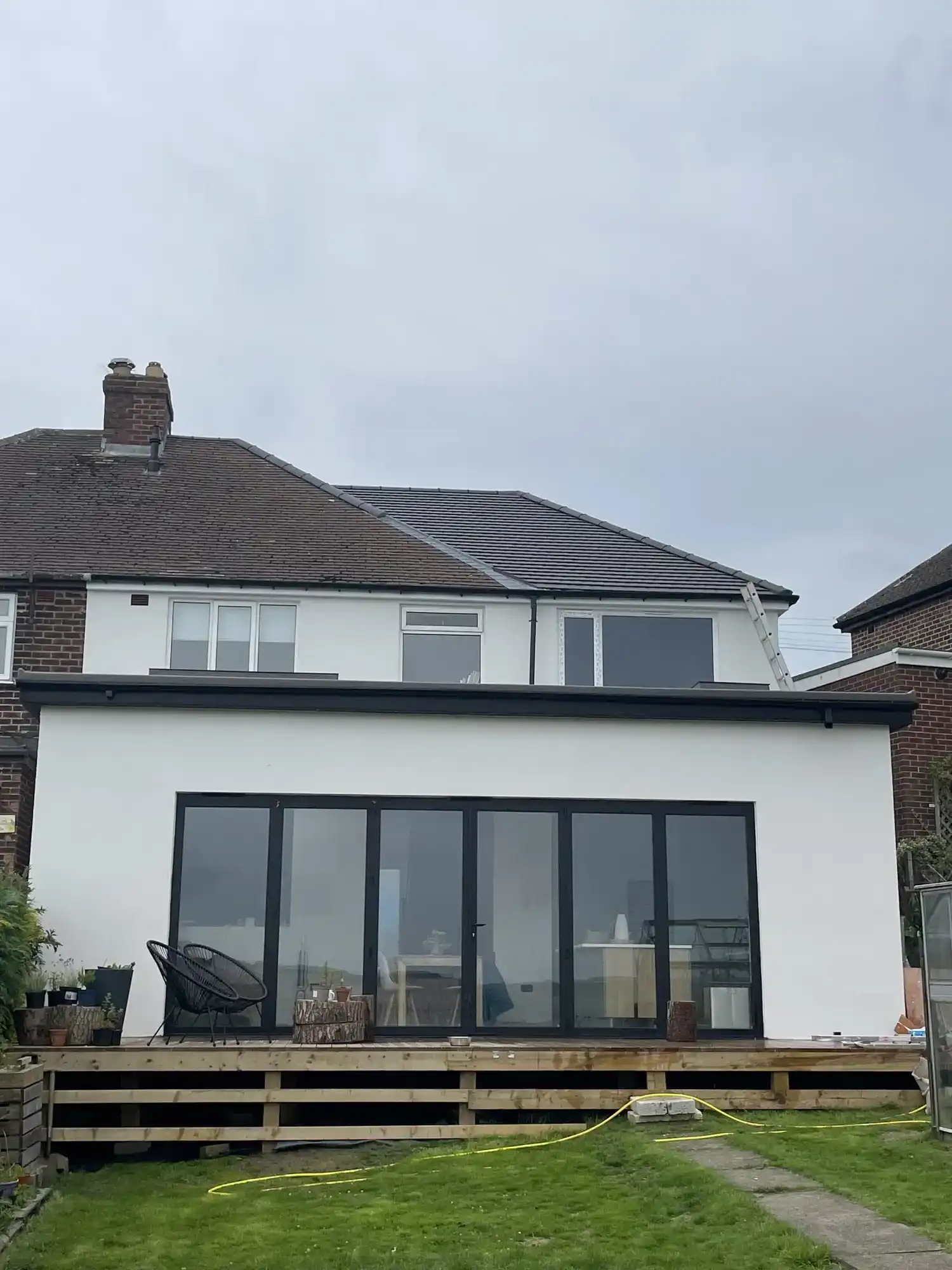
Sandygate — before & after
Ecorend silicone · 1:07
Base coat application
Sheffield property · P&R Solutions
The Exact Process We Follow
Select a service below to see every stage of our application process — nothing hidden, nothing skipped.
With correct application and no maintenance required
For a standard semi-detached property
Before any material is mixed, we carry out a full substrate assessment — tapping for hollow sections, checking for damp, inspecting existing render adhesion. Any failing areas are cut back to sound masonry. Window and door reveals are protected. This stage determines everything that follows.
FoundationA fibre-reinforced, polymer-modified base coat is applied to the entire surface. This coat provides structural strength, bridges minor surface irregularities, and creates the mechanical bond between the substrate and the finished render system.
Layer 1High-grade alkali-resistant fibreglass mesh is pressed into the wet base coat across the full elevation. This reinforcement layer allows the system to flex with the natural movement of the building, preventing the hairline cracking that plagues cheaper installations.
Layer 2 — CriticalA second thin coat is applied over the mesh and ruled flat. This produces the perfectly smooth, uniform surface that silicone render requires for a consistent texture and colour. Any undulation at this stage will show through the finished coat.
Layer 3A colour-matched primer is applied once the base coat has cured. This step is never skipped — it ensures optimal adhesion between the base system and the silicone topcoat, and dramatically improves colour uniformity and richness in the finished product.
Layer 4The premium silicone render is applied in your chosen colour and texture — fine, medium, or coarse (1.5mm grain). Silicone is hydrophobic and self-cleaning: water beads off the surface rather than soaking in, which prevents algae growth and staining. The colour runs through the full depth of the material, so minor scuffs are invisible.
Layer 5 — FinishWant to see silicone render up close? View the full silicone render service page or request a free survey.
UV-stable integral colour throughout the full depth
Single coat combining base and finish coat strength
We tap test the entire elevation to identify hollow, loose, or delaminating material. Any failing sections are cut back to sound masonry. We also check for damp penetration, cracks, and movement that could affect adhesion. Nothing is covered up — every issue is addressed before the first coat goes on.
FoundationA professional bonding primer is applied to the prepared surface. This equalises suction across the substrate — critical with monocouche because uneven suction causes colour patching and adhesion failure in the finished coat. We never skip this step.
PrepMonocouche render is applied in a single thick coat of 12–15mm, combining the structural strength of a base coat with the aesthetics of a finish coat. The material is gauged to exact consistency and applied by hand in sections, maintaining a wet edge to prevent joints showing in the finished surface.
Main ApplicationBefore the render fully sets, the surface is textured to the agreed finish. Scraped finish gives a smooth, stone-like appearance by drawing a straight edge across the surface. Roughcast finish adds aggregate for a more rustic, textured look. Timing is critical — too early and the render smears; too late and it won't work.
FinishThe colour is mixed uniformly throughout the monocouche material before application — not painted on afterwards. This means the colour runs through the full 12–15mm depth, delivering UV-stable results that won't fade, peel, or require repainting for 20+ years.
ColourMonocouche requires a full 7–14 day cure to achieve maximum hardness, adhesion strength, and weather resistance. We advise against high-pressure washing or impact during this period. After full cure, the surface is extremely durable and requires no ongoing maintenance.
CuringReduction in heating costs after EWI installation
For a standard residential property including scaffolding
We begin with a full building survey, moisture assessment, and thermal modelling. This calculates the existing U-value of your walls, models the improvement achieved with different insulation thicknesses, and confirms the correct specification. No guesswork — we give you the numbers before work starts.
SurveyProfessional scaffold is erected around the property. The existing wall surface is thoroughly cleaned and inspected. Any defects — cracks, damp patches, loose material — are repaired before insulation goes on. The damp-proof course is inspected and bridging risks assessed.
PreparationInsulation boards — EPS (expanded polystyrene), PUR (polyurethane), or Mineral Wool depending on specification — are adhesive-bonded and mechanically fixed to the wall. Boards are staggered at joints, cut tightly to window and door reveals, and laid with zero gaps. Any gap is a thermal bridge and a future failure point.
Layer 1 — CriticalEvery board joint, external corner, window reveal, and wall penetration is fitted with purpose-made profiles and sealed. This eliminates thermal bridges — the gaps in the insulation envelope where heat escapes. Skipping this stage compromises the system's thermal performance significantly.
DetailingA polymer-modified base coat is applied over the insulation boards. Alkali-resistant fibreglass mesh is embedded into the wet base coat across all elevations. This reinforcement layer provides structural integrity and crack resistance for the render finish above.
Layer 2The chosen finish render — silicone, monocouche, or acrylic — is applied over the prepared base coat in your chosen colour and texture. Silicone is the premium choice for EWI due to its flexibility and hydrophobic properties, allowing the system to breathe while resisting water ingress.
Layer 3 — FinishOnce complete, a full elevation inspection is carried out. We check adhesion, render coverage, edge details, and surface finish. Warranty documentation is issued — both our 5-year workmanship guarantee and the manufacturer's system warranty. You pay only when you're satisfied. No deposit ever.
HandoverApplied in two passes, trowelled to a hard smooth finish
Before decorating — plaster must be uniformly white
We tap test walls and ceilings to identify hollow, loose, or blown plaster. We check for damp, staining, and movement cracks. Any structural issues or damp sources are identified and flagged before we start. A fair quote is only possible once we know exactly what we're working with.
AssessmentAll loose and hollow plaster is removed back to the sound substrate. The surface is cleaned of dust, grease, and contamination. Masonry is dampened to control suction. PVA bonding agent is applied where required. Metal angle beads are fixed to all external corners to produce crisp, durable arrises.
Prep — CriticalOn masonry surfaces, a bonding or scratch coat is applied at 8–11mm to build up to the required depth and provide a mechanical key for the finish coat. On plasterboard surfaces, scrim tape is applied to joints before jointing compound and a base skim are applied.
Layer 1The first coat is ruled off with a feather-edge straight across the full surface of the wall or ceiling. This produces a flat, level plane for the finish coat to sit on. Any undulations, hollow spots, or high points are corrected at this stage. A flat first coat is the foundation of a perfect finish.
LevellingFinish plaster is applied in two thin passes at 2–3mm total. The first pass is laid on and spread flat; the second pass is applied before the first fully sets. The surface is worked with a trowel in wide arcing passes, and finally laid off to a hard, smooth finish completely free of trowel marks, lines, and air bubbles.
Finish — Layer 2Fresh plaster needs 2–4 weeks to dry fully before decorating, depending on thickness, ventilation, and temperature. We advise on the correct drying conditions — gentle ventilation, no direct heat, windows slightly open. We carry out a full quality inspection with you before leaving site. 5-year guarantee. Zero deposit.
HandoverStandard centres for metal stud dry lining frames
For jointed and skimmed dry lining to be ready to decorate
Walls and ceilings are measured and the installation method agreed — dot and dab adhesive, direct fix, or metal stud framing. Services (pipes, cables, sockets) are identified and mapped. Insulation specification is confirmed. Thermal and acoustic requirements are discussed to ensure the right board and thickness selection.
PlanningFor dot and dab installations, masonry is cleaned and checked for plumb; adhesive dabs are applied at standard centres. For metal stud systems, floor and ceiling track is fixed, vertical studs are installed at 400mm centres, and the frame is checked for plumb and level throughout.
PreparationBoards are cut to size, offered up, and fixed into the adhesive dabs or screwed directly to the metal studs. Tapered edges are aligned for jointing. Cut edges are kept to internal corners where they'll be covered by the joint finish. Boards are checked for flatness as each sheet goes up.
Layer 1Scrim tape is pressed into all board joints and internal angles. Metal angle beads are fixed to all external corners. Jointing compound is applied over the tape, feathered out wide to either side, and left to set. A second pass may be required on wider boards or where movement is expected.
JointingA 2–3mm skim finish coat is applied over the full boarded area and worked to a hard, smooth finish. The surface dries ready to decorate in 2–4 days. A final inspection is carried out with you on completion — checking flatness, corner accuracy, and overall finish quality. 5-year workmanship guarantee issued. Zero deposit.
FinishFrequently Asked Questions
Answers to the questions Sheffield homeowners ask most about render and plastering application.
A typical semi-detached house takes 3–5 days from start to finish, including base coat, mesh, primer, and topcoat. Larger properties or those requiring more extensive preparation may take longer. We'll give you an accurate timeline at your free site survey.
In most cases, yes. If the existing surface is sound and well-bonded, we apply a reinforcing mesh base coat then the silicone finish over the top. Where sections are hollow, cracked, or failing, we strip those areas back to the masonry first. We always carry out a full substrate assessment and explain exactly what's involved before work starts.
Silicone render is a multi-layer system — base coat, mesh, primer, and silicone topcoat — delivering the longest lifespan (25+ years) and best water resistance. Monocouche is a single thick coat (12–15mm) that's faster to apply and gives a more natural stone-like appearance. Both are excellent; the best option depends on your property, budget, and aesthetic goals.
Most residential EWI projects take 5–10 days depending on the property size and complexity. This includes scaffolding, board installation, base coat, and finish render. We'll provide a detailed schedule at your free survey — no vague estimates.
Before plastering we remove any loose or hollow material, clean the substrate back to a sound surface, dampen masonry to control suction, apply PVA bonding agent, and fix angle beads to all external corners. Good preparation is what separates a lasting finish from one that cracks or fails within a few years.
Fresh plaster typically takes 2–4 weeks to fully dry, depending on thickness, room temperature, and ventilation. We advise clients to keep windows slightly open, avoid direct heat, and not to decorate until the plaster has turned uniformly white and is fully dry to the touch.
No deposit required. We believe trust is earned through quality work, not upfront payments. You only pay once the work is completed and you're completely satisfied with the result. This policy applies to every job we take on.
All our work comes with a 5-year workmanship guarantee. The materials we use — silicone render, monocouche, EWI systems — carry manufacturer guarantees of up to 25 years. You're covered on both the materials and our installation quality.
Ready toTransformYour Home?
Free site survey. Fully itemised quote. Zero deposit. Sheffield's most trusted rendering and plastering specialists — rated 5.0★ across 100+ Google reviews.